
A platform team can standardize on OpenTelemetry, deploy a Collector in every Kubernetes cluster and still be unable to answer the question that matters during an incident: Can we trust this telemetry?
The trace may exist, but service ownership is missing. A latency metric may spike, but its labels make production and staging impossible to compare. Logs may describe the failure but carry no trace context to connect them to the request. Meanwhile, a new attribute can quietly create millions of metric series and turn a useful platform into an expensive archive.
OpenTelemetry provides a common way to emit, move and describe telemetry. It does not, by itself, make telemetry complete, safe, correlated or affordable. That missing layer is a telemetry quality gate.
The Operating Problem
Most teams treat instrumentation as an application concern and the Collector as plumbing. Developers add libraries, exporters are configured and ownership begins only after data reaches the back end. By then, defects are distributed across dashboards, alerts, saved queries and runbooks.
Consider a checkout service on an otherwise mature internal platform. It sends traces successfully but reports service.name as ‘checkout-api’, ‘checkout ’, or an auto-generated default, depending on the language team. One team puts the customer identifier in a metric label. Another writes it into the log text. A third emits exceptions without trace IDs. All three services are instrumented. None is reliably operable at platform scale.
This is not an OpenTelemetry failure. It is a contract failure. Semantic conventions provide a shared vocabulary, but a platform still has to decide which fields are mandatory, which attributes are forbidden and what happens when data breaks the rules.
What a Telemetry Quality Gate Does
A telemetry quality gate is a set of automated checks that evaluates telemetry before it becomes a dependency for operations. It should classify each signal as accepted, repaired, quarantined or rejected — not merely collect it and hope dashboards reveal defects later.
Start with five checks that have immediate operational value:
- Identity and Ownership: Require a stable service name, environment, workload identity and an owning team or escalation route.
- Semantic Consistency: Enforce approved resource attributes and operation names. POST/orders/{id} is useful; a raw URL with a unique order ID is not.
- Cross-Signal Correlation: Verify that logs generated within a traced request include trace and span context, and link key metrics to traces where appropriate.
- Cardinality Control: Detect attributes with unbounded value sets, including user IDs, request IDs, email addresses, timestamps and full URLs used as metric labels.
- Data Safety: Block or redact secrets, authorization headers, tokens and personal data before they reach a shared back end.
Where Quality Gates Fit in the Telemetry Pipeline
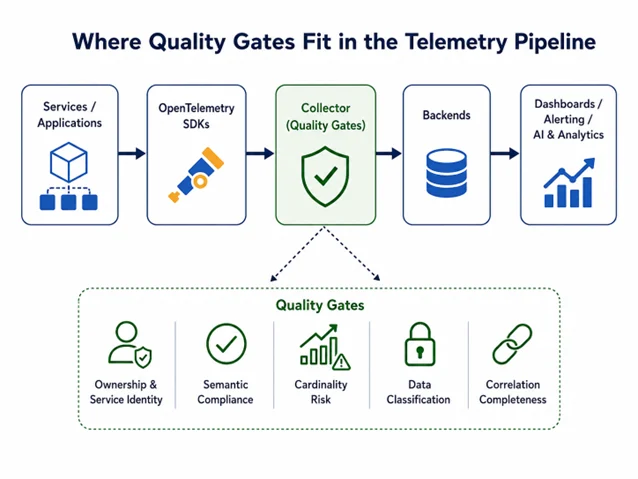
Not every failure should drop production telemetry. A missing owner tag may be repaired from a namespace-to-team mapping. A forbidden attribute should be redacted. An unknown service or metric with a cardinality breach may go to a quarantine stream and appear as a delivery failure to its owning team. The action should match the risk.
Build Gates in Two Places
Enforce quality before deployment and while data is in motion.
At design time, put a minimum contract in the service template, Helm chart, deployment library or developer-portal blueprint. A new service should inherit context-propagating log configuration and baseline health signals. CI can validate configuration and run a synthetic transaction that proves traces, logs and metrics arrive with the required context.
At runtime, apply the same rules in the OpenTelemetry Collector path. A gateway Collector offers one controlled point to enrich Kubernetes metadata, normalize attributes, apply redaction and filters and emit quality metrics. That is better than maintaining separate, inconsistent rules in every language repository.
A contract can be small:
telemetry_contract: required_resource_attributes: - service.name - deployment.environment.name - platform.owner required_correlation: - logs.trace_id prohibited_attributes: - authorization - user.email cardinality_risks: - request.id - user.id - url.full
The syntax matters less than the ownership model. The platform defines defaults and policy; service teams own exceptions. Exceptions should be explicit, versioned and reviewable rather than silently becoming a new back-end cost.
Measure Trust, not Just Volume
Ingest rate and storage consumption matter, but they do not show whether telemetry supports an incident response. Add a quality scorecard for every service and track:
- Signals with complete ownership and environment metadata
- Logs correlated to active traces
- Cardinality-policy violations by team
- Sensitive-data redactions or blocked exports
- Time from a violation to owner acknowledgement
- Services meeting the minimum observability contract
Do not create another compliance dashboard that developers ignore. Use the findings to improve the golden path. If many teams omit ownership metadata, the template is wrong. If every Java service fails log correlation, fix the shared library. Quality gates should expose platform friction, not merely blame application teams.
A Practical Rollout
Start with one high-value request path: Checkout, provisioning or authentication. Define the smallest useful contract, instrument one service end to end and test whether an on-call engineer can move from alert to owner, trace, log evidence and runbook without guessing.
Publish findings in pull-request checks, service-catalog scorecards and release-readiness views. Make enforcement progressive: Warn first, quarantine high-risk data next and reserve hard rejection for attributes that create a security exposure or severe back-end instability.
The Takeaway
OpenTelemetry standardizes the telemetry pipeline. Platform engineering makes that pipeline dependable.
A service is not observable merely because it emits spans, logs and metrics. It is observable when the platform can identify the workload, connect the signals, protect the data, control the cost and direct an engineer to the person who can act.
Telemetry quality gates turn emitted data into operational evidence before the next incident asks more of it than the platform can prove.