
Every platform engineering team has a mental model of its users: Application developers who want to ship without filing tickets, paved roads that make the right thing the easy thing and guardrails that keep the wrong thing from happening. In 2026, that user base quietly gained a new persona — one that never sleeps, reads documentation instantly, and will happily run a thousand API calls before lunch. The AI agent has become a first-class consumer of the internal developer platform (IDP), and it changes the platform team’s job more than any tool since Kubernetes.
The instinct to treat this as someone else’s problem is understandable and wrong. As platform engineering’s own commentators have started arguing, mature platforms in 2026 will “treat agents like any other user persona, complete with RBAC permissions, resource quotas, and governance policies.” The agent is not an exception to your platform. It is one of its users.
The Platform Becomes the Agent’s Interface
Here is the shift in one sentence: The IDP stops being only a portal for humans and becomes a control plane that agents consume programmatically.
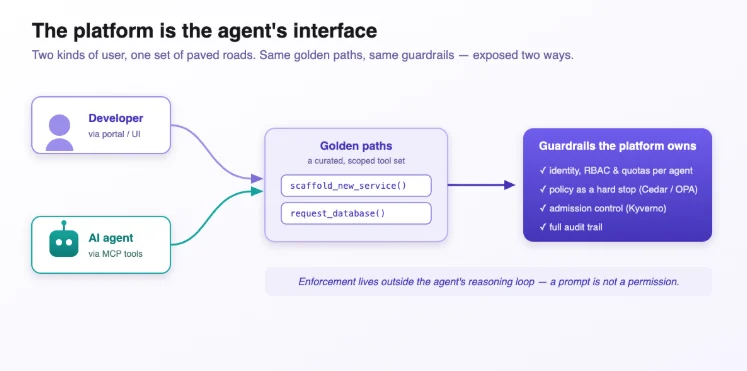
When a developer uses a golden path today, they click through a Backstage template or a service catalog and the platform scaffolds a compliant repo. When an agent uses that same golden path, it does the equivalent through a machine interface — discovering the available capability, filling in the parameters, and opening a pull request. The Model Context Protocol (MCP) is what made this practical almost overnight; by exposing platform actions as MCP tools, you let an agent invoke your paved roads the same way a developer invokes them through the UI. Microsoft’s platform-engineering team framed it neatly: The agent becomes “the control-plane interpreter, continuously mapping intent to the underlying API layer with governance enforced end-to-end.”
The critical design decision is what you expose. You do not hand the agent raw kubectl and the whole AWS API and wish it luck. You expose a curated, explicitly scoped set of tools — a scaffold_new_service action, a request_database action — that encode your golden paths. The Backstage community is already doing exactly this, with MCP backends that let AI clients discover and trigger scaffolder templates as native tools. The platform’s value proposition doesn’t change; its interface gains a machine-readable surface.
The AWS Building Blocks Already Exist
If your platform runs on AWS, most of the primitives an agent needs are now generally available, and they map cleanly onto platform-engineering concerns.
- MCP servers turn AWS services into agent tools. The open-source Amazon EKS MCP server lets an agent manage clusters and workloads through a bounded, flag-gated toolset (read-only by default), and the managed AWS MCP server — generally available in 2026 — exposes thousands of AWS API operations behind a small, auditable set of tools.
- Amazon Bedrock AgentCore, now generally available, is the runtime layer: Serverless hosting with per-session isolation, an identity service that integrates with your existing IdP (Cognito, Okta, Entra ID), a gateway that turns APIs and Lambda functions into MCP tools, and — importantly for platform teams — a Cedar-based policy service that enforces deterministic guardrails on tool calls at runtime, independent of IAM.
- Open frameworks keep it vendor-portable. The Apache-licensed Strands Agents SDK builds an agent in a handful of lines, and CNCF projects like kagent and HolmesGPT bring agentic troubleshooting into the cluster itself. None of this requires betting your platform on a single proprietary stack.
The point is not that AWS sells an “agent platform.” It’s that the platform team now has the same caliber of building blocks for its newest persona that it has long had for human developers.
Golden Paths and Guardrails — for Machines
A platform team’s job has always been to balance enablement against control. With agents, both sides get sharper.
On enablement: Define agent golden paths the same way you define developer workflows. An agent that wants to stand up a service should traverse the same approved blueprint a human would — the same compliant Terraform module, the same Kyverno-validated manifests, the same cost and security defaults baked in. Done well, this is a genuine multiplier: Golden paths steer AI-generated scaffolding toward compliant patterns automatically. Done poorly, the inverse bites hard — a neglected platform means AI assistants amplify your dysfunction at machine speed.
On control: Give every agent its own identity, scoped credentials, RBAC and resource quotas — the same primitives you apply to people and CI, now applied to a non-human caller that can act far faster. Enforce policy outside the agent’s reasoning loop, because a prompt is not a permission. AWS’s security guidance is explicit that controls “must be established before the agent runs,” and that any permission you grant an agent can and will be exercised. Use the aws:ViaAWSMCPService context key to tell agent-driven calls apart from human ones in your policies, route changes through admission control, and keep a structured audit trail of every action an agent takes.
The Job Shift
This is the part worth sitting with. The platform engineer’s center of gravity moves from managing human developer workflows to architecting governance frameworks that accommodate autonomous callers. Golden paths, guardrails, safety nets and human review — the four pillars of platform control — don’t get replaced by AI. They become the thing that makes AI safe to adopt at all. Industry surveys are blunt about the gap: Only about a fifth of organizations have mature governance for autonomous agents, even as the agents arrive in production.
The platform team that thrives in the agentic era won’t be the one that bolts a chatbot onto its portal. It will be the one that recognized, early, that its job was never to control who builds — only to define what safe building looks like — and then extended that definition to a user that happens to be a machine.