
TL;DR — Key Takeaways
- A platform can report healthy infrastructure while workloads still fail because their underlying identity and trust relationships have drifted.
- Platform teams need to distinguish infrastructure state, workload identity state and trust state because each can diverge independently.
- A trust-aware platform should declare intended trust relationships, observe what actually exists at runtime and reconcile differences when identities, credentials, issuers or policies drift.
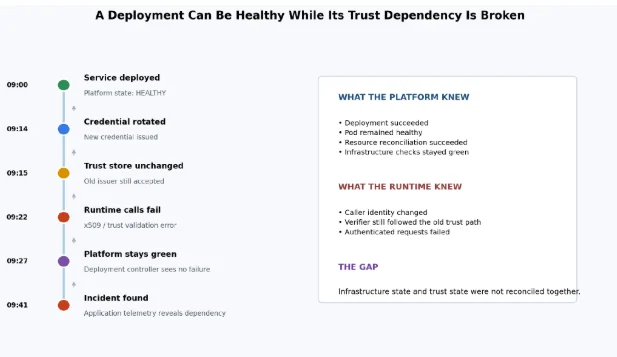
A platform team deploys a new version of an internal service. The pipeline passes. Kubernetes reports the pods as ready. The deployment controller reaches the desired replica count. Infrastructure reconciliation is clean, and nothing in the platform dashboard looks unusual.
Then another service starts returning TLS errors.
Nothing is obviously down. The workload is running. The network path exists. DNS resolves. CPU and memory are normal. Yet authenticated requests are being rejected because the two workloads no longer agree on the trust relationship used to establish their identities.
This is the kind of failure that exposes a gap in platform architecture. The platform knows a great deal about whether infrastructure exists and whether workloads are running. It may know much less about whether the identities, credentials, issuers and trust stores behind those workloads still agree.
That distinction becomes increasingly important as internal developer platforms move from provisioning infrastructure to creating entire runtime environments. A golden path does not just create a deployment. It can create service identities, cloud roles, certificates, keys, policies and the relationships that allow those objects to trust one another.
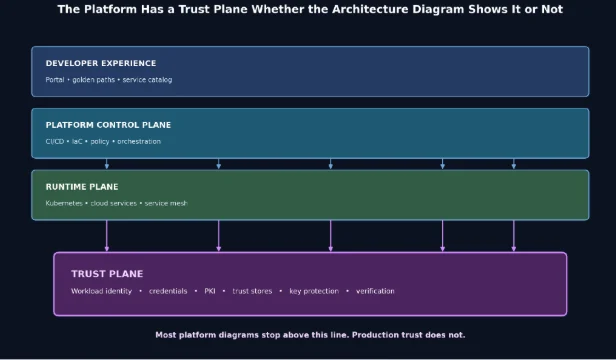
The dependency is real even when the architecture diagram does not show it.
The Platform Has More Than One Kind of State
Platform engineering is fundamentally about managing state. Infrastructure-as-code describes what resources should exist. Kubernetes controllers continuously reconcile workloads against desired state. CI/CD systems track the movement of software from source to production. Policy engines evaluate whether configurations satisfy defined constraints.
Trust introduces another state model.
A workload can exist in the desired state while its credential is expired. A certificate can be valid while its issuer is no longer the intended authority. A trust store can contain an outdated CA while every application using the host appears healthy. A private key can remain accessible after the workload that originally received it has been replaced.
These are not necessarily infrastructure failures. They are discrepancies between the trust relationship the platform intended to create and the trust relationship that exists at runtime.
That is why a platform architecture needs to distinguish at least three related states: infrastructure state, workload identity state and trust state. Treating all three as one problem usually leaves the third implicit.
What the Runtime Actually Depends On
Take a service-to-service request that uses TLS or mutual TLS. The application does not simply need a network route. The caller needs an identity, a credential representing that identity, access to the associated private key, and a certificate chain or other proof that the receiving side can validate.
The receiving side has its own dependencies. It needs a verifier, a set of trusted authorities or keys, policy describing which identities are acceptable, and enough information to determine whether the presented proof belongs to the caller it expects.
A single request therefore crosses several control boundaries before the application code sees the response. The platform may manage each component through a different system, but the runtime experiences them as one trust decision.
This is why trust is better understood as a relationship than as a security object. The certificate matters because of its issuer. The issuer matters because of the verifier’s trust configuration. The private key matters because it proves possession of the identity represented by the public key. The identity matters because a policy associates it with an allowed action.
The Trust Relationship Is the Missing Architecture Object
Platform diagrams are comfortable drawing objects. A workload is an object. A service is an object. A cluster is an object. An IAM role is an object. A certificate is an object.
Trust lives between them.
Consider a simple relationship: Service A may authenticate to Service B using Workload Identity X, with a credential issued by Authority Y, while Service B accepts Authority Y under Policy Z. That relationship has an owner, a lifecycle, a scope and a failure mode.
If the platform changes the workload but not the identity, the relationship can become stale. If it rotates the credential but leaves the verifier on an old trust path, the relationship can break. If it deletes the workload but does not retire the credential or authorization path, the relationship can outlive the infrastructure that created it.
The architecture problem is therefore not that platforms lack identity. Modern platforms are creating identities at scale. The problem is that the relationship connecting identity, proof and acceptance is often spread across systems that do not share the same lifecycle model.
Why This Is Different From Ordinary Configuration Drift
Platform engineers already know how to reason about drift. A desired Kubernetes deployment can be compared with the running deployment. A Terraform plan can reveal infrastructure differences. A configuration controller can restore a declared value.
Trust drift is more subtle because the actual state can remain syntactically valid.
A CA can still be valid and yet no longer belong in a trust store. A certificate can still be within its validity period and yet be associated with a retired workload. A credential can still authenticate successfully and yet have a broader scope than the platform intended. A private key can still work while existing outside the approved protection boundary.
The system is not necessarily broken. The relationship is wrong.
That makes trust drift especially difficult to detect with ordinary infrastructure monitoring. The platform needs to know not merely whether an object is present, but whether the objects around it still form the relationship that policy intended.
The Lifecycle Problem Starts When the Platform Creates the Identity
This is already visible in current platform work on machine identities, which describes how platform workflows create Kubernetes service accounts, cloud roles, pipeline identities and other machine identities as a consequence of provisioning workloads. The architectural implication is important: the platform is not merely deploying software. It is participating in the creation of the identities that software uses.
The same logic applies to certificates. PKI provides the trust infrastructure that connects certificates, public keys, certificate authorities and verification. In a platform environment, those relationships become runtime dependencies that need to follow the workload lifecycle rather than live in a separate administrative process.
Rotation Is Not Complete Until Verification Changes
A common mistake is to define credential rotation as the moment a new credential is issued. In a distributed platform, issuance is only one step.
The new credential has to reach the intended workload. The workload has to use the corresponding private key. The receiving service has to accept the new chain or identity. The old credential has to stop working when policy requires it to stop. And the platform needs evidence that the intended state is actually serving production traffic.
That final verification step matters because deployment success does not prove trust success. A certificate can be renewed in a secret store while a load balancer, service mesh, sidecar or application continues presenting an older credential. Conversely, a verifier can continue trusting an old issuer after the platform believes the migration is complete.
A trust-aware lifecycle therefore ends with verification, not issuance.
The Platform Should Be Able to Explain a Trust Failure
Imagine an incident where Service B suddenly rejects Service A. The first useful question should not be “which certificate expired?” It should be “what changed in the trust relationship between these two workloads?”
A mature platform should be able to answer that question from its own state and telemetry. It should identify the caller’s workload identity, the credential being presented, the issuer or authority behind it, the verifier’s trust configuration, the policy that permits the interaction, and the last lifecycle event affecting each dependency.
This is where platform observability needs to move beyond infrastructure health. A pod being ready tells the platform that the process is running. It does not tell the platform that the process can still establish every trust relationship required for its business function.
The distinction is similar to the difference between checking that a database is reachable and checking that an application can authenticate to the database using the identity it is supposed to have. The second question is closer to what the user actually experiences.
A Trust-Aware Platform Adds a Reconciliation Loop
The architectural answer is not another dashboard. It is a reconciliation loop.
First, the platform declares the intended relationship. Service A should have identity X and may authenticate to Service B under policy Y. The platform then provisions the credential and the supporting trust configuration.
Next, the platform observes runtime evidence. Which identity is actually being presented? Which certificate or credential is active? Which issuer is being accepted? Has a trust store changed? Is the retired credential still usable?
Finally, the platform reconciles differences. It can rotate a credential, update a trust relationship, revoke an obsolete identity, or escalate a discrepancy when automated correction would be unsafe.
This is familiar platform-engineering logic applied to a different class of state. The objective is not to make every trust decision centralized. It is to make the intended relationship explicit enough that the platform can detect and manage divergence.
What Belongs in the Platform Model?
The model does not need to become a catalog of every cryptographic detail. It needs enough information to connect the pieces that determine whether a workload can establish trust.
At minimum, that means workload identity, owner, credential type, issuer, key-protection location, verifier or relying service, trust policy, environment, lifecycle status and dependency relationships.
Ownership matters because trust failures often cross team boundaries. Security may control the CA. The platform team may control workload provisioning. An application team may own the service. Operations may see the incident. Without a shared relationship model, every team can be correct about its own component while the end-to-end interaction is broken.
The platform should therefore make trust discoverable in the same way it makes deployment information discoverable. A developer should not need to understand the entire PKI implementation, but the platform team should be able to explain what identity a workload receives, how that identity is verified and what happens when the workload is replaced.
This Becomes More Important as Platforms Serve Agents
The shift toward autonomous software makes the trust problem harder rather than simpler. AI agents as platform users are already becoming part of the platform architecture, bringing identity, guardrails and bounded access into the runtime model. The missing architectural question is how the platform keeps the trust relationships behind those decisions visible as the agent’s runtime behavior changes.
An agent may be authorized to invoke a tool, but the platform still has to establish who the agent is, how that identity is represented, what credential proves it, which service accepts it, and when the relationship expires. security as a platform primitive becomes much more concrete when those controls are embedded into the workflows that create and operate the agent rather than added as a separate approval layer.
The Measure of a Trust-Aware Platform
The first useful measurement is coverage. How many production workloads have a known identity, owner, credential, issuer and verifier relationship? An inventory that covers only public certificates says little about the trust surface inside Kubernetes, CI/CD, cloud IAM and service-to-service communication.
The second is freshness. Trust information changes as quickly as infrastructure changes. A six-month-old inventory is not evidence of current control when workloads and credentials are continuously created and destroyed.
The third is lifecycle performance. How quickly can the platform issue an identity? How quickly can it rotate a credential? How quickly can it revoke an identity after a workload is retired or a key is suspected of compromise?
The fourth is reconciliation. How many unexpected trust relationships are detected? How many are automatically corrected? How many require a human to investigate?
Those measurements tell a platform team something that ordinary deployment metrics cannot: whether the platform can continuously establish that the trust relationships it created are still the relationships the organization intends to have.
The Dependency Was Always There
Platform engineering succeeded by absorbing complexity. Developers no longer need to understand every infrastructure primitive behind a standard deployment because the platform turns those primitives into repeatable workflows. Trust needs the same treatment.
The platform already creates workloads, identities, credentials and policies. It is already involved when a service establishes mTLS, when a pipeline federates into a cloud account, when a workload receives a credential, and when a service is retired. Those are trust operations whether the platform team describes them that way or not.
The next step is to make the relationship explicit. A platform architecture that shows only developers, pipelines, clusters and services is incomplete. The missing layer is the system that determines whether those components recognize one another, what evidence they accept, and how that trust changes over time.
Trust is not an external security detail attached to the platform. It is one of the dependencies that allows the platform to work at all.