
Harness has extended the scope of its internal developer portal (IDP) to enable platform engineering and DevOps teams to holistically manage an entire environment.
Manisha Sahasrabudhe, senior director of product for Harness, said Harness Environment Management (EM) is an automation framework that unifies the management of continuous integration/continuous delivery and infrastructure-as-code (IaC) platforms to enable software engineering teams to manage DevOps workflows at a higher level of abstraction.
Deployed as an extension to the Harness IDP platform, the overall goal is to automate the manual ticket-based processes in a way that goes beyond exposing tools and services to developers to enable software engineering teams to more easily manage the entire software development lifecycle (SDLC).
At the core of this latest addition to the Harness portfolio are Environment Blueprints, a set of reusable, standardized templates that describe the elements of an environment, including infrastructure resources, application services, dependencies, and configurable inputs such as versions or replica counts. Role-based access control and versioning are also embedded directly in those definitions to help ensure governance policies are not bypassed and that workflows can be audited.
Infrastructure is then provisioned via the Harness IaC Management platform, while services are deployed via the Harness CD platform. That capability makes it possible for application developers to spin up a development environment in minutes and, just as importantly, have it automatically be torn down to keep total costs under control, said Sahasrabudhe.
Harness EM also includes a drift detection capability that surfaces differences between the blueprint and the running environment, allowing teams to detect issues earlier.
In effect, Harness EM creates a living catalog within the IDP versus simply presenting a set of static portal services, said Sahasrabudhe.
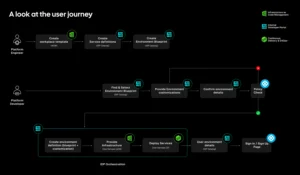
Mitch Ashley, vice president and practice lead for software lifecycle engineering at the Futurum Group, said Harness EM provides a control plane capability to unify provisioning, deployment, governance, and drift detection under a single system.
In contrast, existing fragmented environments produce compounding liabilities: drift accumulates undetected, ephemeral environments multiply without cleanup, and compliance audits expose gaps between running infrastructure and declared code, he added. Teams running disconnected toolchains for infrastructure and delivery will carry that operational debt as platform complexity grows, noted Ashley.
It’s not clear at what pace software engineering teams are moving to unify workflows, but a recent Cloud Native Computing Foundation (CNCF) survey finds that while more than a quarter (28%) work for organizations that have a dedicated platform engineering team responsible for internal platforms, another 72% have adopted a multi-team approach (41%) or have no formal approach at all (31%).
Regardless of approach, there has arguably never been more focus on developer productivity. As the pace at which code can be developed has accelerated in the artificial intelligence (AI) era, it’s already become apparent that developers need to be able to spin environments up and down faster than ever. Otherwise, before too long it will soon become obvious to all concerned where the bottlenecks in software engineering workflows might really lie.