
TL;DR — Key Takeaways
- AI agents can automate repetitive platform tasks, enforce compliance and make internal developer platforms more self-service.
- Traditional platforms built for predictable workflows need to evolve for autonomous agents that operate through observe-plan-act-reflect cycles.
- Supporting agentic systems requires stronger state management, cognitive observability and governance built directly into the platform.
All enterprises are changing how they enable developers to produce software quickly without compromising security, compliance, or budgets. However, organizations often face challenges from manual workflows, inconsistent guidelines, and overworked platform teams.
Enter AI agents, which use large language models (LLMs) as their agents, helping by automating recurring tasks, helping guarantee compliance, and allowing Internal Developer Platforms (IDPs) to be self-sufficient powerhouses.
In this article, we will discuss how autonomous AI agents have been helping platform engineering.
Why Do We Need AI Agents in Platform Engineering?
Besides enabling developers to deliver software more quickly with a focus on compliance, cost-effectiveness and security, platform engineering is changing how companies support developers. Many organizations are still dealing with the problems of manual processes, inconsistencies in standards, and overworked platform teams.
This is where AI agents, using large language models (LLMs) and frameworks like LangChain, can help. AI agents will allow companies to automate the tedious aspects of developing software, enforce company policies, and convert internal development platforms (IDPs) into self-service centers.
What is Platform Engineering?
Platform engineering is a logical extension of DevOps that enhances DevOps practices, but with less cognitive stress. It reduces the complexity of the typical DevOps process by creating a platform that gives developers a unified toolset for building and deploying applications.
Platform engineering takes the concept of DevOps forward and offers an option that sidesteps the shortcomings of manual methods. The automation of development and deployment pipelines means that it is more efficient and effective than conventional approaches.
Business organizations can use platform engineering as part of their digital transformation efforts to succeed in today’s rapidly changing technology landscape.
Platform engineering teams use an Internal Developer Platform (IDP) to reduce time spent on traditional DevOps activities by providing a unified set of tools for developing and deploying applications. An IDP lets platform teams provide simpler, more effective ways to complete tasks once handled by DevOps teams.
The platform engineer’s role does not replace DevOps; instead, it extends the ideas that have made DevOps so successful in helping organizations address new problems and opportunities. The platform engineer’s role will be extremely important in the days to come as we stride into the enticing journey into software development and delivery.
Limitations of the Current Platform Engineering Approaches
The traditional Platform Engineering methods work really well in facilitating synchronous, predictable operations such as the following:
1. A user sends a request (Input)
2. Code processes data according to defined rules (Transformation).
3. The system provides the output (Output).
Contrary to this, the autonomous agents operate in an Observe-Plan-Act-Reflect cycle. These agents follow non-linear processes to achieve specific objectives and may sometimes fail gracefully in an unexpected way, which current monitoring solutions are unable to foresee. If your platform is designed to support standard programming and predictable state changes, you may find it breaking when faced with real autonomy.
The Pillars of Autonomous Resilience
To support AI agents effectively, platforms must also transform into an advanced AI operating system. To do this, platforms need to develop three major pillars: State Management, Observability, and Governance.
Dynamic State Orchestration (The Brain)
Traditional microservices are composed of databases and caches to manage state. However, states in autonomous agents are composed of both internal memory, external context and the combined knowledge of many agents involved in the process. For your system to function properly, you need to create a type of persistent context storage that uses graph database technology.
Cognitive Observability (Seeing the Black Box)
When it comes to debugging a microservice, everything is relatively simple as all you need to do is to check the logs and different metrics associated with the error code. Traditional logging often falls short; instead, we need cognitive observability to debug autonomous agents. If you want to debug the agent you need to figure out its reasoning.
Governance and Safety Layer (Ethical Guardrails)
More autonomy equals greater risk when there is just one mistake. Faulty agents can make many transactions in a short period of time without any manual input; therefore, governance must be built into the system itself.
Figure 1 illustrates the first layer of defence against agent actions using a policy check mechanism. It demonstrates how the risk assessment process determines if an agent should be tested in a constrained sandbox environment, if the agent requires human intervention, or if the agent’s request may be safely rejected, and what corrective action is recommended.
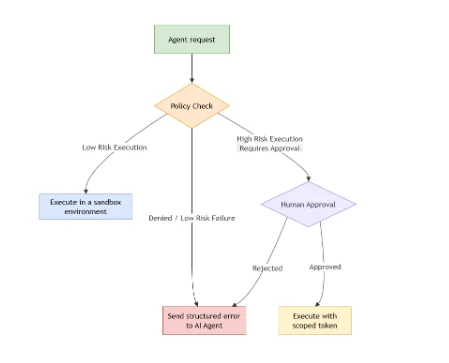
Figure 1
Basically, each request passes through the policy engine first. A manual approval is required only if there are any high-risk requests.
Takeaways
- Enterprise software delivery is undergoing a radical transition as artificial intelligence and platform engineering come together to transform the developer experience.
- As large language models and agentic AI systems generate vast amounts of code, the traditional software development model based on manually written code is being challenged.
- We need to see platform engineering as more than building the most effective pipeline possible. Instead, we should be able to view our role as enabling the reliable application of intelligence.
- The objective of this shift in engineering philosophy is not simply to increase the speed of system operations (CPU cycles, network latency) but rather to provide mechanisms for controlling the amount of operational complexity of the systems being built.
- If an organization is interested in utilizing complete autonomy, then the platform that hosts the application will become the main source of intellectual property for the organization.
- A platform should have sufficient robustness to handle the cognitive risk associated with the growing capability of agents.